Sunday, October 24, 2010

Figs & Honey: Honoring the Sensuous and Sensual


On 10.10.10 we were productive here on Aileen Street.

The goals for the day: Extract and jar honey and make fig jam. 
We are alll about the YUM here in Oakland.

Here are some interesting facts to think about:
* A honeybee's wings stroke 11,400 times per minute. Bzzzzzzzzz.....
* Honeybees are the only insect that produce food for humans.
* Honeybees can travel as far as 3 miles from their hive.
* Honeybees are responsible for pollinating 80% of all fruit, vegetable, and seed crops in the U.S.
* To make a pound of honey, the bees in the colony must visit 2 million flowers, and fly over 55,000 miles.
* A single honeybee will produce 1/2 a teaspoon of honey in her lifetime.

* Figs are believed to be the first agricultural plants grown by humans.
* Figs are of great nutritional value, and a great source of energy for athletes.
* If you are lactose intolerant: 1/2 a cup of figs = 1/2 a cup of milk!


We first had to pick the beauties from our abundant tree......plump & purple & sweet!


It takes time and energy to make sure all of the lids and jars are sterile. 
But it is satisfying to see the line-up of multiple forms.........


Scott Ward does not usually like the taste of fig...
Things have changed.

Ok....now for the honey venture.......


You need something called an extractor that looks like R2D2.....


7 frames of capped honey...that is what we had to work with....


You also need a special knife that enables you to carefully open 
up the cells to reveal the golden nectar. 


 Once the frames have been spun, the honey trickles into glass jars....


In the end we jarred 10 lbs. of beautiful Oakland honey.
Scott also loves the waxy yumminess that is like candy.
Thank you amazing bees! 
The honey is sweet and amber colored: tastes of lavender and citrus tickle the tongue.


Sunday, October 10, 2010

Aileen Street Yum

Tomatoes.
Dreamy.
There are as many as 7, 500 varieties and are divided into categories depending on shape and size.
And the heaviest tomato known was 7 lbs 12 oz. WOW.
But we struggled this year.
Not enough heat? Watering issues?
We spent a lot of time wondering and worrying about our tomatoes.....BUT the below images are a sight to behold.
Tomato sauce! Created from the Aileen Street tomatoes!
We were proud.
And our bellies happy.

Freshly plucked orbs: Please note: Shot taken up close. Behind these orbs marched a bounty in the thousands......


Nothing better than making your own saucy sauce:
Purely tomato, olive oil, garlic, and thyme


And here you have it: fresh garlic and parsley pasta with fresh tomato sauce and some sauteed chard.
Come on over anytime.

Saturday, October 2, 2010

.....When a rope is not just a rope...........


"Discovery is the ability to be puzzled by the simple things." 
~ Noam Chomsky 

Today I was surprised by the graceful elegance of the ropes laid to rest at the climbing gym.


And then I was struck by the curl on the girl taking photographs and the shadow being cast.


And the curve of the lit curve struck my eye.


And the cascading grace of the telephone curl.


Friday, October 1, 2010

bzzzzzzzzzz..........

Thinking about bees......Always thinking about bees.......

Here is Marla Spivak: one of this year's MacArthur genius grant recipients....
Amazing.


http://www.youtube.com/watch?v=W_0FPF1Smwk


Here is text from her website.

Marla Spivak is an entomologist who is developing practical applications to protect honey bee populations from decimation by disease while making fundamental contributions to our understanding of bee biology. Essential to healthy ecosystems and to the agricultural industry as pollinators of a third of the United States' food supply, honey bees have been disappearing at alarming rates in recent years due to the accumulated effects of parasitic mites, viral and bacterial diseases, and exposure to pesticides. To mitigate these threats, Spivak's research focuses on genetically influenced behaviors that confer disease resistance to entire colonies through the social interactions of thousands of workers. Her studies of hygienic behavior—the ability of certain strains of bees to detect and remove infected pupae from their hives—have enabled her to breed more disease-resistant strains of bees for use throughout the beekeeping industry. Spivak's "Minnesota Hygienic" line of bees offers an effective and more sustainable alternative to chemical pesticides in fighting a range of pests and pathogens, including the Varroa mite, a highly destructive parasite that spreads rapidly through Western honey bee colonies. By translating her scientific findings into accessible presentations, publications, and workshops, she is leading beekeepers throughout the United States to establish local breeding programs that increase the frequency of hygienic traits in the general bee population. With additional investigations into the antimicrobial effects of bee-collected plant resins under way, Spivak continues to explore additional methods for limiting disease transmission and improving the health of one of the world's most important pollinators.

Marla Spivak received a B.A. (1978) from Humboldt State University and a Ph.D. (1989) from the University of Kansas. She has been affiliated with the University of Minnesota since 1993, where she is currently Distinguished McKnight Professor in the Department of Entomology. She is the author and creator of numerous beekeeping manuals and videos, and her scientific articles have appeared in such journals as the Journal of Neurobiology (now Developmental Neurobiology), Evolution, Apidologie, and Animal Behavior.

Monday, September 27, 2010

Adventures in Bee Keeping in 94608

Today was a beautiful morning to go through the hives.
Hot, but not too hot.
Birds were chirping, and hopefully the tomatoes are growing.....we are slowly seeing signs of progress and ripening.....

Here are the hives: Hive A (left): super active   Hive B (right): mellow hive


It has been a month since we have looked through the hives. It takes about an hour each hive, and most beekeepers go through them every 28 days.
We are excited and ready.....


Here are the basic tools you need:


A smoker: Scott really likes this tool. It is hot and requires fire...and the smoke makes the bees sleepy, and has a calming, mesmerizing effect on them.


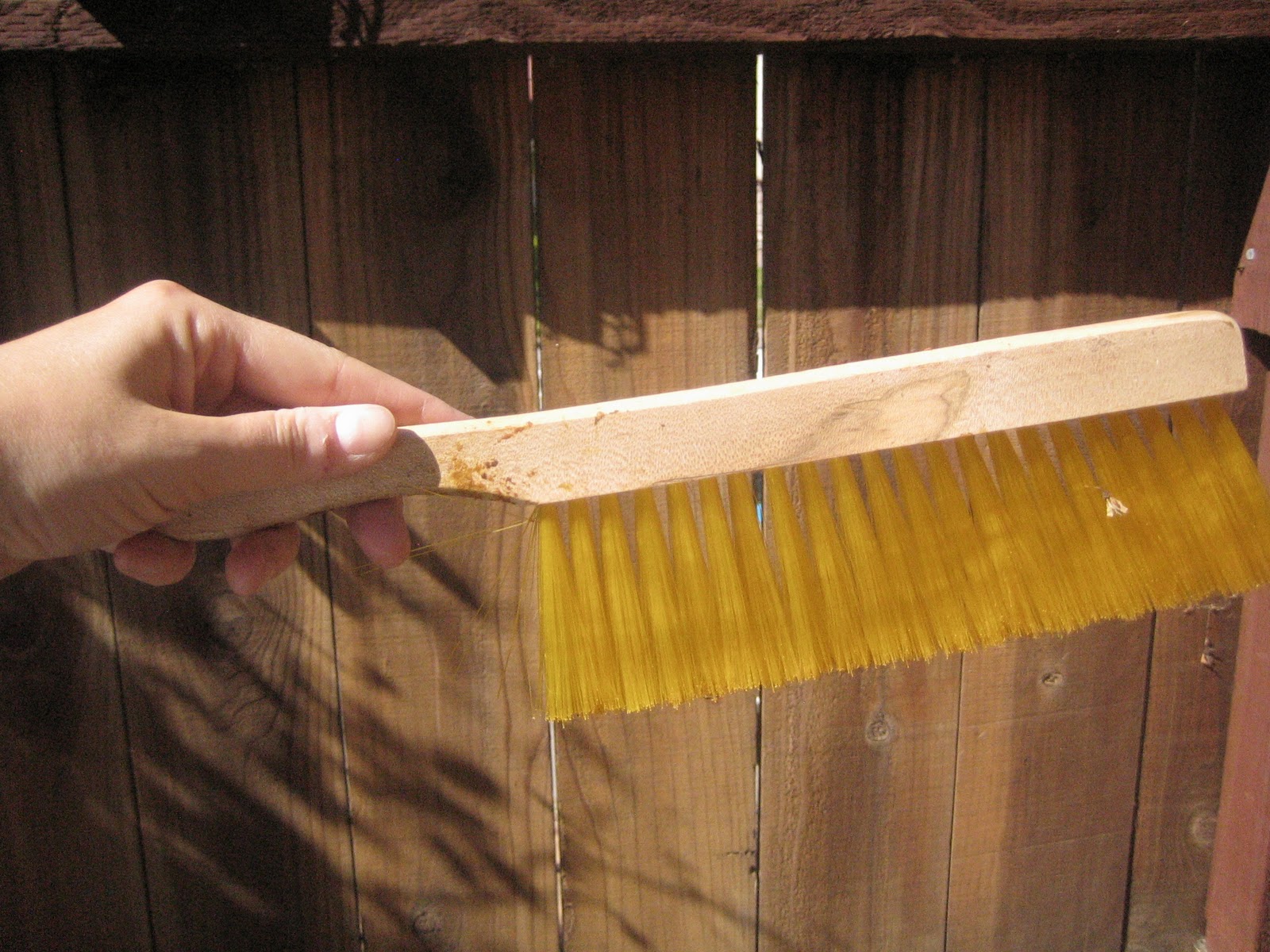
A brush: assists in many different situations; primarily when you are re-stacking the boxes and need to encourage the bees to get out of the way...


A hive tool: Is akin to the common pry bar. It has two important functions: helps pry open hive boxes that are stuck together due to built up propolis, and the hive tool helps to scrape off any excess sticky parts.


Gloves: These pictured are a bit thick and awkward, but there have been occasions when we have been stung on the fingertip and the finger swells up so significantly we have decided to always have our hands protected....latex gloves also work well.


Here we go...............................Hive A........


Checking things out in the honey super.......


Using the hive tool to clean and then pry....


That is a lot of bees....our hives probably have 30,000 bees in each of them......


Today our goal was to find the queen in each hive and clean out the drone traps.....


Here is a drone trap clear out:
Much more humane to place it in the freezer and then compost the comb.....


And for more excitement watch this:


http://vimeo.com/15313140


Thursday, July 22, 2010

Scott Day Snaps

For 25 consecutive days I photographed Scott at 7am.
I used the Hipstamatic Iphone app with the John S lens.
At that time of day he is sleeping and dreaming and preparing for wake.
Below you can see some of the images:


Saturday, May 15, 2010

Ramen&Slides......

........What could be better?
A night of feasting and looking with loved ones at Aileen Street.
All in celebration of Scott.
Yum.


What is Ramen?
David Chang from Momofuku restaurant in NYC describes Ramen as "broth with noodles in it."
Every Ramen shop has its own distinctive style and recipes. How thin they slice the pork. Some add a heave dose of soy to the broth.....some add much more fat to the broth....... You could fill up notebooks and notebooks with jottings on ways to create a Ramen soup.......

We prepared for a week:

And the lists were long......


We had no idea what we were getting into...........

This book became our bible, and we were totally in awe:


Sunday night we began making the pork buns. Steamed. Then frozen for Friday.
Monday night we began the broth -  that simmered for 9 hours. We then contained it......


Tuesday night we pickled. Beets. Cucumbers. Onions. And got the memma (bamboo shoots) ready...


Wednesday night we chopped and prepped.
Thursday night was the roasting of the pork belly and pork shoulder.


And Friday was the party.
People gathered.
Sake was served.
Pork buns were re-steamed. Hoisin sauce, chopped scallions, and picked cucumbers sandwiched pork belly.
Yum.
Then the Ramen was served. Hot broth with noodles. People dressed it as they wanted. Poached egg??
Fish cake? Two pieces of nori? Sauteed collard greens with corn?
Yum.
Mochi was then served.
The slide projector turned on.
Images floated towards us. The selections inspired oooohs and ahhhhs.........
Bellies full of love.
Nothing better.
The love is on.
This was the perfect sight this morning: Remnants left on the porch: